
Unplanned machine downtime is rarely caused by a failure that appears without warning.
Rotating machinery often begins to show signs of deterioration well before a breakdown occurs. Changes in vibration, temperature, speed or load can indicate that bearings, shafts, motors, pumps or other mechanical components are no longer operating under normal conditions.
The challenge is detecting those changes early enough to act.
For maintenance teams, production managers and plant engineers, vibration monitoring can provide an important additional layer of information about machine condition. Instead of waiting for a component to fail or relying only on scheduled maintenance intervals, vibration data can help identify changes that deserve investigation.
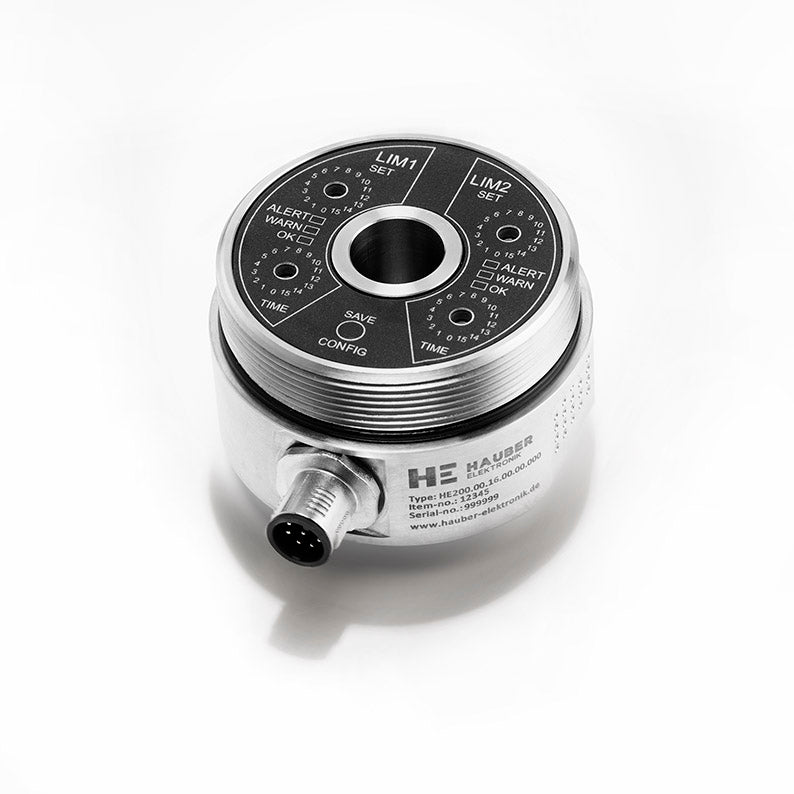
Switches International has expanded its industrial monitoring portfolio with two new vibration-monitoring products — the HE200 and HE205.
Both products are designed around machine and equipment vibration monitoring, helping industrial users move toward a more condition-based approach to maintenance.
For South African manufacturing, mining, food and beverage, materials handling, process and OEM environments, these products provide additional options for monitoring critical rotating machinery and improving visibility of equipment condition.
Why vibration monitoring matters
Every rotating machine produces vibration.
Electric motors, pumps, fans, blowers, generators, conveyors and similar equipment all create a normal vibration signature while operating.
The important question is not whether vibration exists.
It is whether the vibration is changing.
Increasing or abnormal vibration can be associated with issues such as:
Bearing wear
Mechanical imbalance
Misalignment
Shaft problems
Loose components
Mechanical resonance
Damaged rotating parts
Installation problems
Increasing machine stress
Vibration monitoring gives maintenance teams another source of information when assessing machine condition.
Instead of waiting for a bearing to fail completely, teams can identify changing conditions and investigate them earlier.
This can support a shift from purely reactive maintenance toward more preventive and condition-based maintenance practices.
Introducing the HE200 Vibration Monitoring Unit
The HE200 is designed to measure and monitor absolute bearing vibration in machinery.
It can monitor either:
RMS vibration velocity in mm/s
RMS vibration acceleration in g
This allows the device to be used across a range of rotating-machine monitoring applications where vibration behaviour needs to be evaluated.
The HE200 is particularly relevant where maintenance teams need more than a basic vibration measurement.
Its monitoring architecture allows defined vibration limits to be established so that the system can respond when machine vibration exceeds expected operating conditions.
HE200 Product Link:
https://switches.co.za/product/he200/
What makes the HE200 useful for industrial maintenance?
A major benefit of condition monitoring is the ability to distinguish between normal operation and changing machine behaviour.
The HE200 supports this by allowing two vibration limit values to be configured independently.
These can be used to create a staged monitoring approach.
For example:
First threshold: Early warning or pre-alarm
Second threshold: Higher-level or main alarm
This gives maintenance teams the opportunity to respond before vibration develops into a more serious mechanical problem.
A staged alarm strategy can be useful where immediately shutting equipment down at the first sign of increased vibration would be unnecessary, but ignoring the change completely would create risk.
HE200 analogue vibration output
The HE200 also provides a 4–20 mA analogue current output proportional to the monitored vibration level.
This creates opportunities for integration into broader automation and monitoring systems.
Depending on the plant architecture, vibration information may be connected to:
PLC systems
Process controllers
Monitoring systems
Local displays
Alarm systems
Condition-monitoring platforms
A 4–20 mA signal is already widely used in industrial environments, making vibration information easier to incorporate alongside other process measurements such as pressure, flow, level and temperature.
Typical HE200 applications
The HE200 can be relevant for rotating machinery such as:
Electric motors
Pumps
Fans
Ventilators
Blowers
Centrifuges
Separators
Generators
Turbines
Other mechanically oscillating equipment
The exact product configuration should always be selected according to the machinery, measurement requirement and operating environment.
For maintenance teams, the key value is that machine vibration becomes a measurable process variable rather than something noticed only when equipment becomes visibly or audibly problematic.
Introducing the HE205 Vibration Sensor
The HE205 expands vibration monitoring further by offering condition-based monitoring of industrial machines and systems.
It supports vibration measurement through a 4–20 mA analogue output, including:
RMS vibration velocity in mm/s
RMS vibration acceleration in g
The HE205 is designed for demanding industrial applications and operates across a wide temperature range of -40 °C to 125 °C.
Depending on the required version and application, the product can also support functional-safety and explosion-protected environments.
HE205 Product Link:
https://switches.co.za/product/he205/
HE205 and condition-based monitoring
Condition-based maintenance focuses on the actual condition of equipment rather than servicing machinery only according to fixed dates.
This can be particularly useful for critical machinery where:
Failure causes significant downtime
Bearings or rotating parts experience heavy use
Equipment runs continuously
Machine access is difficult
Maintenance windows are limited
Early fault detection has high operational value
By monitoring vibration continuously, abnormal changes can become visible sooner.
This does not remove the need for engineering inspection or planned maintenance. Instead, it provides another layer of information that can help teams decide when closer investigation is required.
Understanding the HE205 window function
One important distinction between the HE200 and HE205 is the way switching thresholds can be used.
The HE205 can monitor a defined vibration window.
This means an acceptable operating range can be established, with the device signalling when vibration moves outside that range.
This can be useful where both unexpectedly high and unexpectedly low vibration conditions matter.
For example, high vibration could indicate a developing mechanical problem, while an unexpected reduction in vibration could potentially correspond with a machine state that needs investigation.
The correct limits must always be determined according to the machine, application and engineering requirements.
HE200 vs HE205: Which should you choose?
The two products are related, but the correct choice depends on the monitoring objective.
Consider the HE200 when:
Absolute bearing vibration needs to be monitored
Two vibration thresholds are useful
A pre-alarm and main alarm strategy is required
RMS vibration velocity or acceleration needs to be monitored
A 4–20 mA vibration signal is required
Rotating machinery condition needs to be monitored continuously
Consider the HE205 when:
Condition-based vibration monitoring is required
A defined vibration operating window is useful
SIL2 / PL d requirements are relevant to the application
A 4–20 mA vibration output is required
Harsh temperature conditions need to be considered
Explosion-protected versions may be required
Machine condition needs to be monitored in demanding industrial environments
The correct selection should be confirmed against the specific machine, required safety level, operating environment and monitoring strategy.
Where do HE200 and HE205 fit into predictive maintenance?
Predictive maintenance is often discussed in terms of AI, IoT platforms and sophisticated analytics.
But effective predictive maintenance starts much closer to the machine.
It begins with reliable measurement.
A maintenance system cannot identify changing machine behaviour if it has no information about what the equipment is doing.
Vibration monitoring can therefore form part of a wider predictive-maintenance strategy alongside measurements such as:
Temperature
Speed
RPM
Pressure
Flow
Machine cycles
Level
Electrical load
Together, these values can help teams build a more complete understanding of equipment condition.
Example: monitoring an industrial pump
Consider a pump operating continuously in a process plant.
Traditionally, maintenance may be performed according to a fixed schedule.
However, if bearing vibration is also monitored, the maintenance team has an additional source of information.
If vibration remains stable over time, the machine is behaving consistently.
If vibration starts increasing, the maintenance team can investigate factors such as:
Bearing wear
Misalignment
Coupling condition
Foundation issues
Cavitation
Mechanical looseness
The vibration sensor does not diagnose the mechanical fault by itself.
Instead, it provides an early warning that the condition has changed.
That difference is important.
Example: monitoring electric motors
Electric motors are widely used across industrial operations.
They drive:
Pumps
Fans
Conveyors
Compressors
Production equipment
Process machinery
Motor problems can result in significant downtime, particularly when the motor drives a critical production process.
Vibration monitoring can help maintenance teams identify changes in motor or bearing behaviour before they develop into more serious failures.
For high-value or production-critical motors, continuous vibration monitoring can therefore become an important reliability tool.
Example: fans and blowers
Fans and blowers can develop vibration because of:
Imbalance
Build-up on rotating components
Bearing wear
Loose mountings
Shaft alignment problems
Because these machines often run continuously, small changes may go unnoticed until noise or vibration becomes severe.
Continuous vibration measurement creates better visibility.
Supporting South African industrial reliability
For South African businesses, unplanned equipment failure can create more than a maintenance problem.
It may result in:
Lost production
Delayed orders
Emergency procurement
Overtime maintenance
Increased spare-part costs
Longer equipment shutdowns
Pressure on production teams
This is especially relevant in industries such as:
Mining
Manufacturing
Food and beverage
Packaging
Materials handling
Water treatment
Process industries
OEM machinery
Condition monitoring gives maintenance teams an opportunity to detect changing equipment behaviour earlier.
For plants in Gauteng, KwaZulu-Natal, the Western Cape and industrial operations throughout South Africa, combining reliable condition monitoring with locally accessible technical support and replacement products can strengthen overall maintenance resilience.
Integrating vibration monitoring with other Switches International products
The HE200 and HE205 can also form part of a broader machine-monitoring strategy.
Vibration Control Sensors and Switches
Explore the wider Switches International vibration monitoring range: https://switches.co.za/product-category/vibration/
Speed Sensors
Machine speed can provide additional condition and process information: https://switches.co.za/product-category/speed/
Rotary Encoders
For rotational feedback, speed and position applications: https://switches.co.za/product-category/rotary-encoders/
Temperature Sensors
Temperature monitoring can complement vibration data when evaluating machine condition.
https://switches.co.za/product-category/temperature/
Electronic Display Controllers
Local process displays can help make monitoring data available directly at the machine or control panel.
https://switches.co.za/product-category/electronic-display-controllers/
Build a more complete condition-monitoring strategy
The most effective maintenance programmes rarely rely on a single measurement.
A more complete strategy could combine:
Vibration + Temperature + Speed + Process Conditions
For example, if vibration rises while machine temperature also increases, maintenance teams have more information to guide their investigation.
Similarly, speed variation combined with increased vibration may indicate a different issue from vibration alone.
The objective is not to collect data simply because it is available.
The objective is to collect information that helps maintenance teams make better decisions.
Questions to ask before specifying a vibration monitoring device
Before selecting the HE200, HE205 or another vibration-monitoring solution, consider:
What machine needs to be monitored?
Which bearing or measurement point is critical?
Do you need vibration velocity, acceleration or both?
What is the normal vibration condition?
What alarm strategy is required?
Is a 4–20 mA output needed?
Will the signal connect to a PLC or another monitoring system?
Is local indication required?
What temperature range does the installation experience?
Is explosion protection required?
Are there functional-safety requirements?
How critical is the machine to production?
These questions help move vibration monitoring from a generic sensor purchase to an application-specific reliability solution.
Frequently Asked Questions
What does the HE200 monitor?
The HE200 is designed to measure and monitor absolute bearing vibration in machinery, using RMS vibration velocity or RMS vibration acceleration as the measurement parameter.
What does the HE205 monitor?
The HE205 provides vibration monitoring for machinery and systems and supports condition-based monitoring with a 4–20 mA analogue output.
What is the difference between the HE200 and HE205?
One important difference is their switching strategy. The HE200 can use two separately adjustable vibration limits, while the HE205 can monitor a defined vibration window. The correct product should be selected according to the machine and required monitoring approach.
Can these sensors support predictive maintenance?
Yes. Vibration information can form part of a predictive or condition-based maintenance programme by helping teams identify changes in machine behaviour before they become major failures.
Can vibration information be sent to a PLC?
Both products support a 4–20 mA analogue signal, allowing vibration measurement to be integrated into compatible industrial monitoring and control systems.
Where can these products be used?
Potential applications include motors, pumps, fans, blowers, generators and other rotating machinery. Suitability should always be confirmed against the specific machine and operating conditions.
Recommended Products:
- HE200 Vibration Monitoring Unit: https://switches.co.za/product/he200/
- HE205 Vibration Sensor: https://switches.co.za/product/he205/
- Vibration Control Switches and Sensors: https://switches.co.za/product-category/vibration/
- Speed Sensors: https://switches.co.za/product-category/speed/
- Rotary Encoders: https://switches.co.za/product-category/rotary-encoders/
- Temperature Sensors: https://switches.co.za/product-category/temperature/
- Electronic Display Controllers: https://switches.co.za/product-category/electronic-display-controllers/
Detect changing machine conditions before downtime becomes the warning
If you need to improve vibration monitoring on motors, pumps, fans, generators or other rotating equipment, speak to the Switches International technical team.
Send us details of:
The machine or equipment type
Current vibration-monitoring requirement
Measurement parameter required
Operating temperature
PLC or control-system requirements
Environmental conditions
Safety or explosion-protection requirements
We can help determine whether the HE200, HE205 or another vibration-monitoring solution is best suited to your application.
Explore the new HE200 and HE205 vibration monitoring solutions from Switches International and start building better visibility into the condition of your critical machinery.